Interferometric Optics Interferometric Optics
|
|---|
| Interferometric Optics
|
|---|
This is a brief description of the N-slit quantum interference computer (NQIC). As explained in the references Dirac's quantum approach is applicable to the propagation of a single photon or to the propagation of ensembles of indistinguishable photons.

Optical architecture for the multiple-prism N-slit quantum interference computer. The beam incident on the N-slit array can be, for example, 25-60 mm wide X 20 µm high thus allowing for the illumination of a very large number of slits.
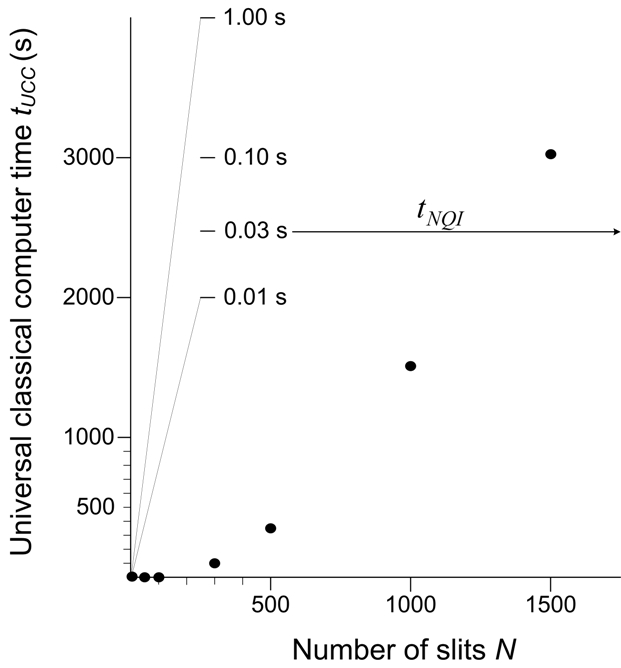
Computational times of a universal classical computer (tUCC) as a function of number of slits in the array N. For all these computations the processing times with the N-slit quantum interference computer tNQIC are in the millisecond range with most of the time consumed by the electronics. Already, before 1995, the quantum interference computer was shown to be ~ 100 000 faster than the universal classical computer integrating photonic plus electronic processing times (tNQIC). If only photonic processing times are considered then the advantage of the NQIC over the UCC shoots up to ~ 10 000 000 000 000 (for N = 1500) since photonic processing times are in the sub nanosecond regime. Original numerical data was published in 1995 and this particular graphical representation is included in Duarte (2026).
The physics of these computations is described by the generalized interferometric quantum probability equation

Comparisons between theory and experiments, in the NQIC configuration, have been performed for even values (N = 2, 4, 6...) and odd values (N = 3, 5, 7...) of N. This includes the cases of two-slit interference, three-slit interference, four-slit interference, up to N = 2000. For reviews see Tunable Laser Optics and Tunable Laser Applications.